


ESA CleanWaves initiative: elevating the industry’s capabilities to optimise RF spectrum usage and preserve it from harmful interference
The CleanWaves initiative was developed by ESA’s Connectivity and Secure Communications Directorate (CSC) at the behest of European stakeholders to advance their capabilities to address emerging challenges related to RF spectrum:
- RF spectrum monitoring
- interference detection, location and mitigation
- and spectrum use
CleanWaves’ objectives are to:
- Identify and anticipate needs, requirements, boundaries and constraints of institutional and commercial users of RF information
- Progress European industrial capabilities through ESA technology development and validation, including in-orbit demonstration activities
- Support technical developments on their path to institutional or commercial markets, including through integration with existing ground-based RF services
The overall goal is to position ESA Member States to be
- better equipped to protect European critical infrastructures from rising sources of interference,
- better prepared to use spectrum resources more efficiently,
- less dependent on non-European technologies and infrastructures and
- better positioned to negotiate and enforce spectrum regulation
RF Spectrum, a globally contested strategic asset
Radio frequency (RF) spectrum is indispensable to the delivery of all wireless services, including those offered by satellite. The rapid proliferation of new, spectrum-dependent services has driven a surge in demand for clean spectrum. In addition, it has intensified competition for bandwidth usage and increased the odds of spectrum interference.
Whether due to congestion or deliberate jamming and spoofing, RF interference disrupts not only consumer connectivity services but also critical infrastructures such as aviation, maritime, emergency response systems, and broader satellite communication services.
In parallel, several nations and many corporations are pioneering spectrum regulations in national and international fora that align with their economic and strategic interests.
What’s more, rapidly evolving technologies are affecting the new balance that the regulatory process must strike between:
- maintaining a stable regulatory framework to protect current licensees and guarantee the reliable delivery of critical services
- fostering innovation and enabling emerging services that depend on timely access to scarce spectrum resources.
Europe is characterised by a diverse regulatory landscape and market environment. RF innovation will enable Europe’s ability to foster a more efficient, flexible, and coordinated use of interference-free radio frequencies, and thus safeguard its economic interests and strategic autonomy.
Regulators and industrial users interested in RF capabilities
In its role to anticipate technology evolutions serving European interests, ESA has undertaken a large stakeholder consultation cycle as of 2024, currently continued bilaterally and multilaterally.
As part of these consultations, stakeholders have emphasised the need for proactivity in positioning European stakeholders on the RF spectrum topic. They welcomed ESA support in its role as a neutral and expert enabler. In particular, ESA’s engagement with user communities is seen as essential to fostering collaboration, aligning interests, and supporting early-stage development.
CEPT is investigating space-based RF monitoring and efficient use of spectrum
The European Conference of Postal and Telecommunications Administrations (CEPT) is investigating the topic of harmful interference, RF monitoring from space, and spectrum sharing. In its published Electronic Communications Committee (ECC) Strategic Plan 2025–2030, the CEPT recognises that:
“Spectrum sharing, where technically feasible, can facilitate effective and efficient use of spectrum in both licensed and unlicensed bands. It can promote innovation by enabling easier and more rapid access to spectrum than some traditional models of making spectrum available (such as clearance). Moreover, the emergence of new technologies may enable the implementation of frameworks that facilitate more efficient use of spectrum.”
Read the ful CleanWaves report
In recent meetings, CEPT FM22 (the group dealing with monitoring and enforcement) has published new statistics on harmful interference. These statistics indicate interferences in satellite broadcasting and FSS/MSS services. They can be consulted here.
The European Commission recognises the importance of capabilities to detect and respond to interference
The growing interest of the European Union (EU) in space-based RF monitoring is reflected in its inclusion as a supporting element of the EU Action Plan on Cable Security: “The Commission will integrate space-based RF detection capacities under the EU Space Programme, complementing the use of existing devices and data from subsea operators.”
In addition, European Union Agency for the Space Programme (EUSPA) in its Requests for Information on RFI (RF Interference) payloads and technology for future satellites states that: “GNSS Radio Frequency Interference (GNSS RFI), therefore, poses significant risks to GNSS services, impacting various sectors reliant on accurate positioning and timing, including aviation, maritime, and telecommunications”.
COPERNICUS,the Earth Observation component of EUSPA, aims to define and design concepts for a potential future EU GNSS (Global Navigation Satellite System) RFI Monitoring service from Space.
A Joint White Paper for European Defence Readiness 2030 specifically addresses “The growing hybrid threats […] electronic interference in global navigation and satellite systems” and calls for “EU-wide advanced electronic systems designed to […] protect and ensure the unhindered use of the electromagnetic spectrum for land, air, space and naval forces and operations.”
In addition, an Opinion published by the Radio Spectrum Policy Group on request by the EC, recognises that “mechanisms to address and solve interference, technical studies to address sharing and compatibility may be necessary […] some Member States are engaged in a common satellite monitoring tool enabling collection of data on satellite spectrum usage. This concept might be extended to provide a basis for mutual assessment or confirmation of an interference or noncompliance situation.”
Finally, in his keynote speech at the European Defence and Security Summit on 10 June 2025, Commissioner Kubilius emphasised the critical role of RF monitoring from space, stating that defence readiness in space demands that we “work towards radio‐frequency interference monitoring” as part of the EU’s strategic capabilities in orbit.
In this context, Commissioner Kubilius also emphasised that “ESA has valuable engineering expertise and is the trusted partner of the European Commission” in delivering the objectives presented.
Identifying needs, mapping capabilities: ESA engagement with stakeholders
In order to understand the user needs in the civil domain on the one hand, and the capabilities of the European industry to cater to these needs on the other hand, ESA is engaging with all stakeholders, bilaterally or multilaterally.
On the demand side: ESA has engaged with representatives of National Regulators, commercial and scientific satellite mission operators and their interests groups. All have expressed an interest to better understand the value of space for RF monitoring.

On the supply side: ESA has engaged with companies and public organisations with ground and space-based assets. They have provided information on existing capabilities, and areas for further development.
Past and upcoming CleanWaves public consultations
- 13 November 2025, ESTEC, Noorwijk: ESA Workshop with CEPT FM22
- 4 November 2025, online: ESA MS Industry Briefing on Upcoming ITTs
- 23-26 September 2025 CEPT FM 22 (Monitoring and Enforcement) Regulators Group: ESA has engaged with all CEPT regulators: they are helping identify use cases and qualify solutions
- 27 November 2024: ESA Conference “Clean Spectrum: Driving Innovation and Growth”: bringing together stakeholders of RF spectrum
Current ESA funding opportunities
- Space-based RF Interference Geolocation Leveraging Existing In-Orbit Assets. Closing date: 30/01/2026
- Exploiting the Synergy between Ground- and Space-based RF Monitoring Systems. Closing date: 30/01/2026, 13:00 CET
- Optimisation of the Spectrum Utilisation Leveraging Existing Space- and Ground-based RF Monitoring Systems. Closing date: 30/01/2026, 13:00 CET
Next steps in CleanWaves: exploring a synthetic spectrum environement
ESA Connectivity and Secure Communications is currently evaluating the potential value and benefits of a synthetic environment for spectrum co-existence or interference cases under the CleanWaves initiative. This environment would allow European stakeholders to replicate near real-world spectrum usage scenarios in a secure and controlled setting, enabling testing and validation of advanced spectrum management concepts and techniques without disrupting live systems.
NEWS AND EVENTS

ITA Airways adopts satellite technology developed by ESA and Viasat to upgrade safety and fuel…
Italy's reference airline has adopted the first of its kind satellite technology, heralding the next generation of aircraft communications standards.

ESA’s Iris satcom technology takes to US skies to showcase next-gen su…
The European Space Agency (ESA) has partnered with Viasat, ESSP and its consortium of industry partners to bring Iris secure satellite communications to the forefront of the US aviation sector, as part of a long-standing ESA effort to push space-…

ESA partners with Polish technology company to develop a satcom security solution using post-q…
The European Space Agency (ESA) has selected AROBS Polska for the Post-Quantum Cryptography Algorithms for Satellite Telecommunication Applications (PQC ASTrAL) project.

ESA and ITU collaborate to advance in radio spectrum sustainability
The European Space Agency (ESA) and the International Telecommunication Union (ITU), through a Joint Statement signed at Mobile World Congress 2025, in Barcelona, Spain, agreed to cooperate and collaborate in fostering…

ESA and European Commission partner to develop secure quantum communication infrastructure
The European Quantum Communication Infrastructure (EuroQCI) marks a significant step forward in meeting the EU’s Digital Decade target of being at the forefront of quantum capabilities by 2030.

ESA to support building of Estonia’s Space Cyber Range
Estonia, renowned as one of the world's most digitally advanced nations, is set to enhance Europe's space security capabilities, through the European Space Agency’s (ESA) Space Systems for Safety and Security (4S) programme.

ESA project achieves space-enabled quantum key distribution link milestone
ESA, together with a Starion-led industrial consortium, has marked a significant milestone in quantum communications technology with the successful implementation of a terrestrial quantum key distribution (QKD) link.

Opportunity: Space Applications Supporting Digital Transformation in Public Safety
Digital Transformation is the change of business by altering the business strategy, operations, products, and objectives through adopting digital technologies. By implementing digital transformation, public safety stakeholders can make better…

Invitation to tender: First phase for 4S system & services test bed
As part of the ARTES 4.0 Space Systems for Safety and Security (4S) strategic action, the present Invitation to Tender (ITT) aims to define, specify, and develop the first core elements of an incremental test bed to be used in support of complex…
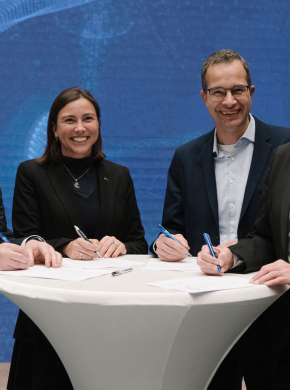
ESA Signs Agreement to Support In-Orbit Demonstration of Spectrum Monitoring Services
The European Space Agency (ESA), RHEA System Luxembourg, LuxSpace Sarl, Aurora Insight and the European Business Reliance Centre (EBRC) are joining forces for the development and deployment of a European Spectrum Monitoring System leveraging…

Industry Info Session: ARTES 4S Prospects
ARTES 4S Strategic Programme Line ("Space systems for Safety and Security") has been created at the last Space 19+ ESA council held at Ministerial level. The aim was to cope with the need of specific efforts towards next generation secure SATCOM…

Opportunity: Space Systems for Safety and Security (4S) Applications
Our society, economy, security and sovereignty are increasingly dependent on digital infrastructures and more specifically on communication networks: any lack of coverage in some areas or loss of availability due to accidental or intentional…